A central heat pump heats and cools the entire house through the ducts you already have. There is nothing on the walls, the temperature is even from room to room, it dehumidifies through the summer, and it does both jobs from one machine. For a ducted house in Montreal or Laval it is usually the strongest option on the table. What follows is what actually decides whether the one you buy performs through a winter here, and only one item on that list is the brand.
1. Sizing, done properly. The most common reason a good machine disappoints is that it was the wrong size. In Canada the calculation follows CSA standard F280-12, which replaced the 1990 edition and sizes cooling capacity to between 80 and 125% of the calculated load. Too small and it never catches up on the worst days. Too large and it short-cycles: it satisfies the thermostat quickly, shuts off before it has removed any humidity, and leaves the house cold and clammy while wearing out its compressor. If a contractor quotes a size over the phone, they are guessing.
2. Your ductwork. This is the single largest variable in what the project costs. If the house already has ducts, installation is straightforward and you are mostly deciding where the outdoor unit goes. If it does not, the quote has to include creating a distribution system, which is a different kind of project. Existing ducts also need to be the right size for the airflow the new unit wants, so a proper assessment includes looking at them rather than assuming.
3. The efficiency numbers, and the fact that they changed. Cooling efficiency is now rated SEER2 and EER2, and heating efficiency HSPF2. These replaced SEER, EER and HSPF in January 2023 under a tougher test, so the same machine scores lower on the new scale: about 5% lower for SEER2 and roughly 15% lower for HSPF2. A SEER 16 figure in an older brochure is not better than a SEER2 15 quote today. The Canadian minimum for new equipment is SEER2 13.4. Our guide to reading heat pump efficiency ratings goes through what each one measures.
4. What it still delivers in a Montreal January. None of the seasonal ratings tell you this, and here it is the number that matters most. Seasonal ratings are averages, and the average is not the problem. The problem is the week in January when it sits below −25 °C for days. Ask what percentage of its rated heating capacity the manufacturer says the unit still produces at −25 °C, and get the answer in writing. A high HSPF2 is worth little if the machine hands the work back to your baseboards on the coldest night of the year. This one question is what separates a cold-climate model from an ordinary one, and it is the reason we do not sell the same equipment here that a contractor sells in Vancouver.
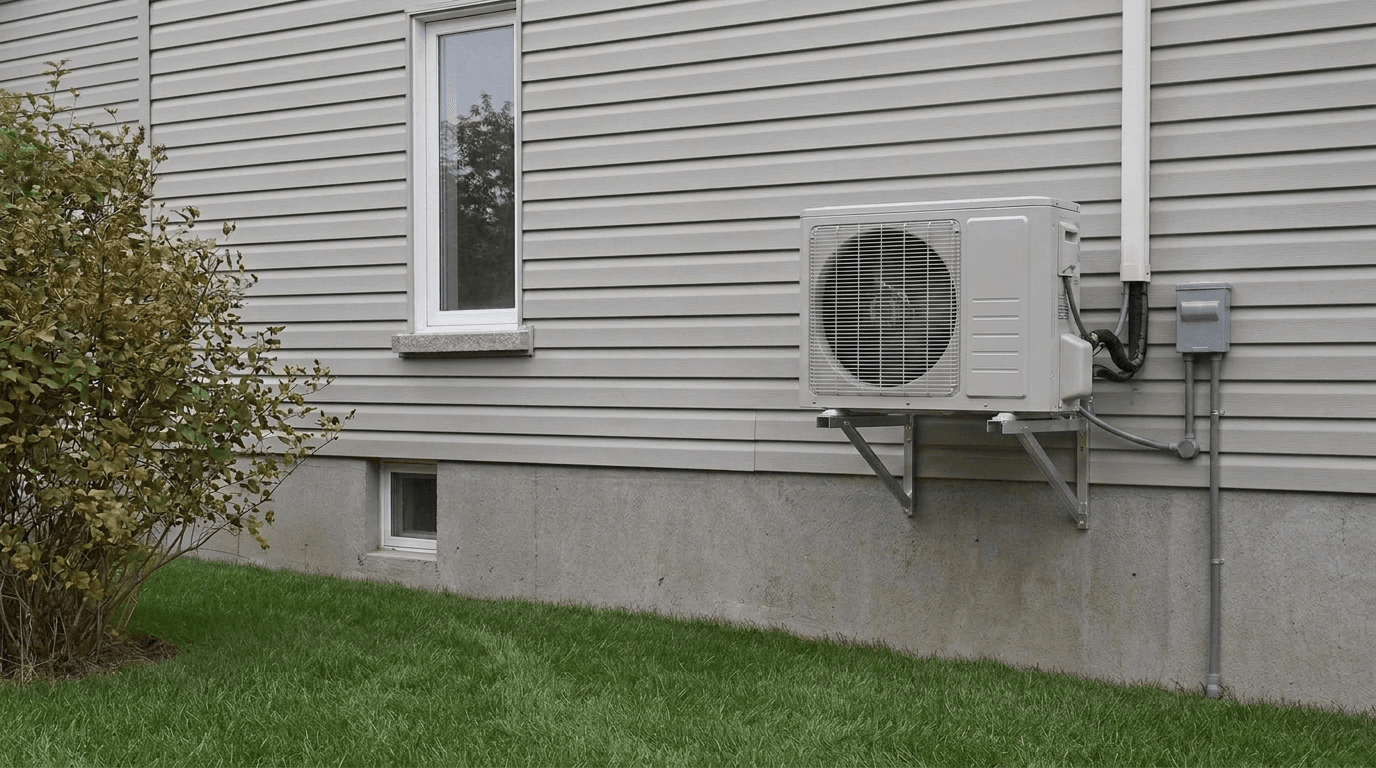
5. Where the outdoor unit goes. Montreal gets more than two metres of snow in an average winter, which is why the mounting matters here as much as the model. The unit belongs on a stand or a wall bracket that holds it clear of the ground, not on a pad that disappears in February. It has to be out from under the roofline, because runoff refreezes and falling ice will destroy a coil. And it needs open space around it for airflow, which on a typical city lot means planning the location rather than defaulting to the side of the house. Sun exposure, which older advice makes much of, matters far less than any of this.
6. Noise, on a city lot. Modern units are quiet rather than silent, and on a Montreal or Laval lot the outdoor unit usually ends up within a few metres of the neighbour’s wall. That makes noise a neighbour question long before it is a bylaw question, and it is the complaint we get called about most often after the fact. Ask for the sound rating in decibels rather than a reassurance, and look at where the unit will sit relative to your bedroom windows and theirs. Easy to get right on installation day, awkward and expensive to move afterwards.
7. The warranty, and who honours it. Most manufacturers cover parts for ten years, often with longer coverage on the compressor, and labour is usually separate and shorter. Ask what each covers, for how long, and who you call. Most warranties also assume the system is being serviced, which is one more reason we recommend two visits a year, one before the heating season and one before the cooling season. Our article on choosing a contractor covers what else to check before you sign.
What we install. We fit York HH8 Series, Moovair and Mitsubishi SUZ and ZUBA central heat pumps. Rather than quote model numbers here, which change year to year, our advisors will match capacity and cold-weather performance to your house and tell you what the differences mean in practice. Efficient models qualify for government rebates, and what is currently available changes often enough to be worth checking before you commit.
If you are weighing a central heat pump against central air conditioning, our comparison of the two sets them side by side. If you have decided and want it sized properly, speak with one of our specialists.