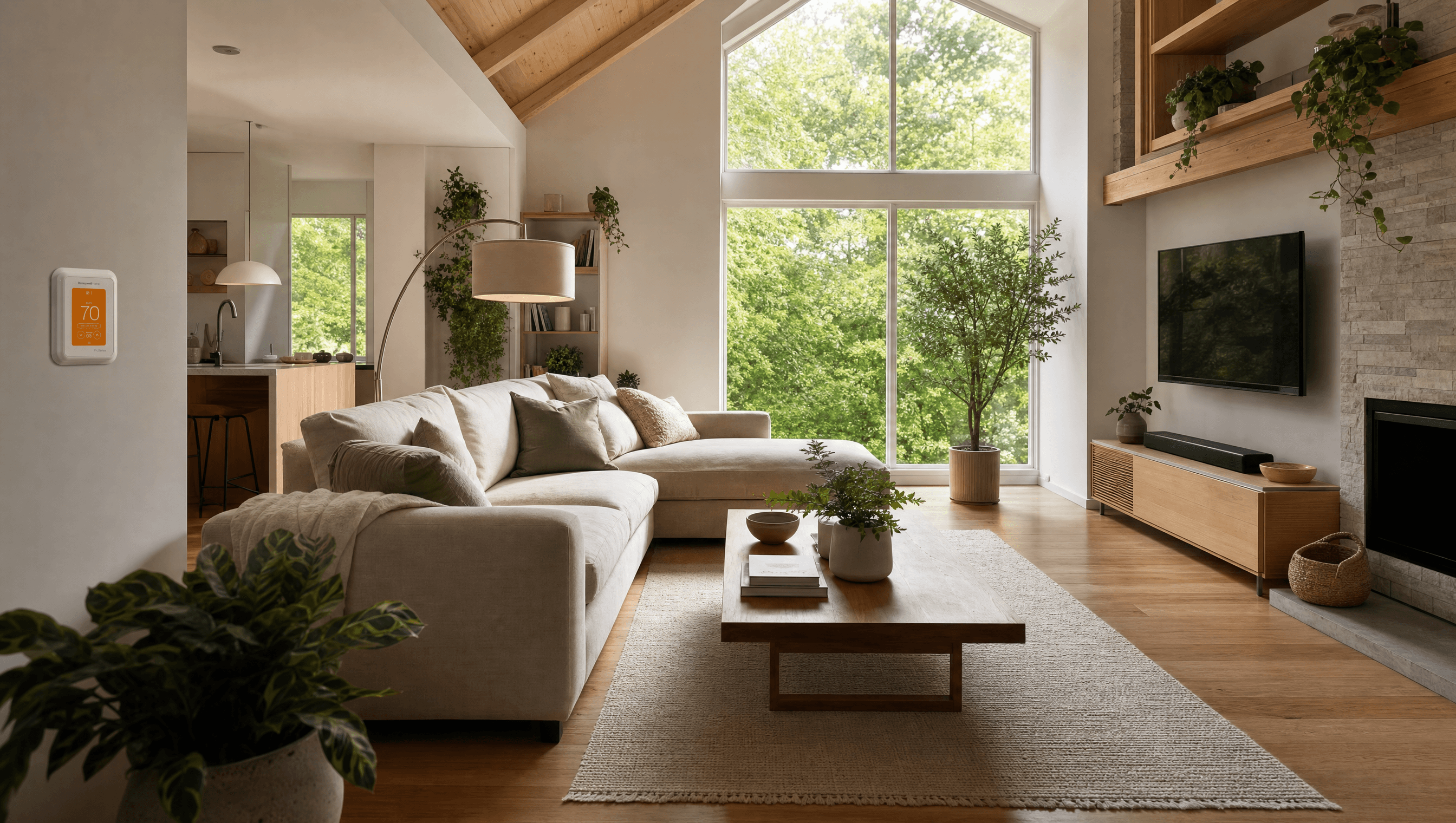
Every house seems to have one: the person who turns the heat up the moment they walk in, and the person who quietly turns it back down. Before you negotiate over a number, it helps to know why two people in the same house can feel such different temperatures. More often than not, the disagreement has a cause you can fix.
Why does one person feel cold when the other feels fine?
People really do feel temperature differently. Activity, clothing and how long you have been sitting still all play a part. But the rooms are often different too. A bedroom over the garage, a basement office or a room with large windows can sit cooler or warmer than the rest of the house, so two people arguing about the temperature may both be right about the room they are in.
Does your thermostat really measure the temperature of the room?
Not quite. A standard wall thermostat has its sensor built in, and it reads the air right around it rather than the room as a whole. Where it is mounted makes a real difference.
Sunlight, a lamp, a television or warmth from the kitchen can make it read warm, so the rest of the house ends up cooler than expected. An outside wall, a drafty hallway or air coming from the wall behind it can make it read cold, so the house runs warmer. And if it sits in a hallway or a room nobody uses, the whole house is being controlled by a spot where nobody actually spends time.
Can the sensor be somewhere else?
On many systems, yes. Some smart thermostats can pair with small wireless sensors placed in other rooms, so the system responds to the rooms people actually use instead of the wall the thermostat hangs on.
Ductless wall units are another case. Many read the temperature at the indoor unit itself, which is usually mounted high on the wall where warmer air collects, so the unit can be satisfied while the people below still feel cool. Depending on the model, the temperature can often be read closer to where people sit instead. Some systems also have an outdoor sensor, but that one helps the equipment decide how to run rather than setting the temperature inside.
If the thermostat is in a poor spot, moving it, adding sensors or changing where the system reads the temperature can settle the argument on its own. We can look at your setup and walk you through the thermostat options that suit it.
Could dry air be the real problem?
Dry winter air can make a room feel cooler than the thermostat says. With comfortable humidity, the same setting tends to feel warmer, and the person reaching for the thermostat often stops reaching. A whole-home humidifier works with your heating system to keep humidity steady throughout the house. If you are not sure humidity is the issue, our article on air exchangers, humidifiers and air purifiers explains which one solves which problem.
What if one room is always too hot or too cold?
A room that never matches the rest of the house often comes down to how air is reaching it: closed or blocked vents, furniture over a register, a dirty filter or ductwork that was never balanced for the house. These are often things a technician can improve without replacing any equipment. Our repair team can find out why one room stands apart from the others.
Can each person have their own temperature?
Yes. When the disagreement is really about different parts of the house, zoning is the lasting answer. A multi-zone system lets different areas run at different settings, and a ductless mini-split can give the room that is always cold its own control. The basement office and the upstairs bedroom stop competing for one thermostat, and everyone sets their own space.
What should your household agree on?
Every household is different, but the agreements that last tend to cover the same ground.
Settle on one daytime setting and one overnight setting, and let a programmable or smart thermostat make the changes so nobody has to. Our tips for staying warm this winter include Hydro-Québec’s guidance as a starting point. From there, keep the setting steady rather than adjusting it through the day, especially with a heat pump.
If one room is always cold, fix that room rather than heating the whole house to make up for it. And when someone feels chilly, check the humidity before reaching for the thermostat.
How does maintenance keep the peace?
A system that is looked after regularly keeps airflow, filters and controls working the way they should, which is a big part of every room feeling right. We recommend two maintenance visits a year, one before the heating season and one before the cooling season. Our annual maintenance plan, called the protection plan, includes both visits. To learn more about what each visit covers, see our maintenance page.
Talk it through with us
If your household cannot agree on the thermostat, we can help work out why. We will look at how your home heats, where the thermostat is and how air reaches each room, then recommend what fits. Get in touch and we will take it from there.